Designing a Scalable Backend Architecture for Multi-Country E-commerce and Marketplaces
Designing a Scalable Backend Architecture for Multi-Country E-commerce and Marketplaces
Growing a global e-commerce business involves much more complexity than just adding shipping countries or translating content. Companies need to function across a range of currencies, tax systems, legal systems, customer expectations, and so on while | being able to perform consistently across these variants at scale. When there is no technical base, inefficiencies and blocking on performance emerge.
A scalable backend architecture becomes the cornerstone of worldwide growth. It empowers companies to manage increasing transaction volumes, provide localized experience, and keep systems reliable across distributed markets. Designing a backend for international e-commerce helps you expand fast, satisfy users, and be sustainable.
Building with Modular Service Layers
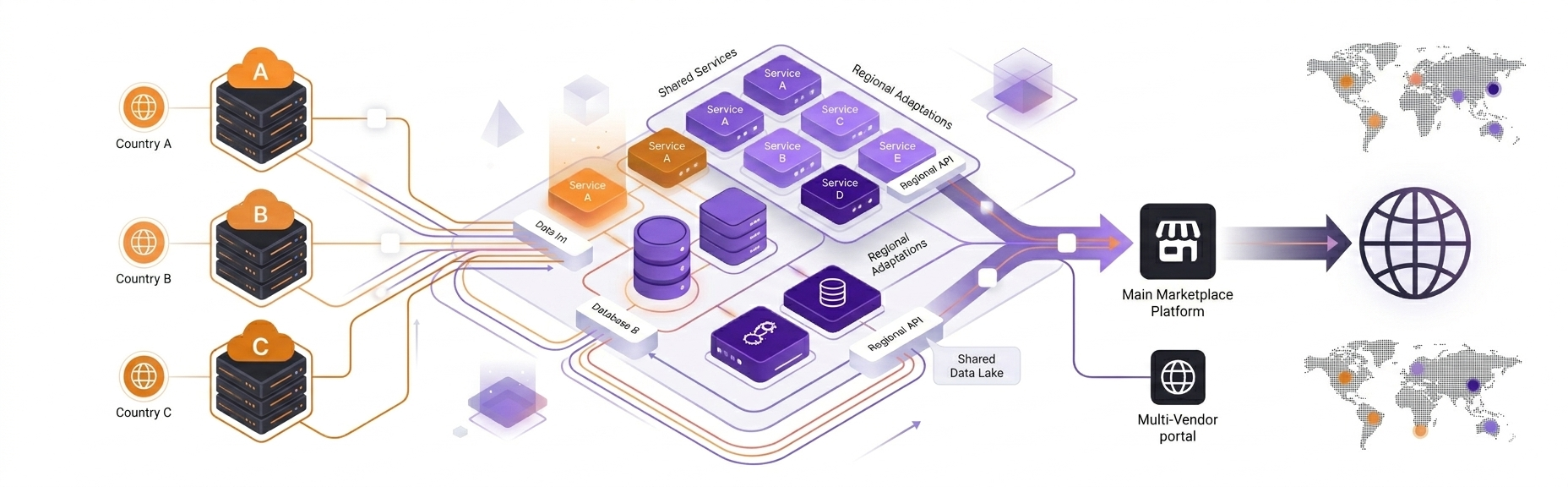
A scalable system starts by having backend functionalities separated into services. The core functionalities required for an e-commerce application should be designed as modular services that interact with each other through APIs. This includes order processing, inventory management, authentication, product catalogs, and checkout, among others.
Such separation boosts flexibility, reducing overall risk. For instance, checkout services can experience unexpected spikes during regional campaigns, while product browsing traffic remains stable. Modular architecture only requires scaling the affected service, which reduces overall infrastructure cost and complexity. It likewise enhances dependability. Failure of a service won’t bring down the others. It matters in international e-commerce platforms where a disruption in one function can affect the general user confidence.
The modular structure makes it easier to connect with third-party systems like logistics providers, tax engines, and regional marketplaces. As companies go global, they can offer custom solutions without revamping the underlying engine.
Data Localization and Regional Infrastructure Distribution
Data management is controlled by performance and regulations according to global platforms. The distance between users and servers can influence the latency, and even minor delays can reduce conversions and engagement. Cloud-based data center backbone technology that brings data services closer to the end-user.
The static assets, such as images, scripts, and more, are cached closer to end users with the help of a content delivery network. This further optimizes the performance of your website and reduces the loading time. Nevertheless, speed is not all that data distribution can do. Many countries have strict laws that specifically require data generated by users to remain within their country's borders. A scalable backend architecture must balance global synchronisation with local storage.
The use of hybrid database strategies is common, wherein data that is sensitive is stored locally to a region, while data that is non-sensitive is synchronized at a global level. These mechanisms ensure that business activities and duplication, failover processes do not halt operation in outages and across regions.
Payment Orchestration Across Borders
Global e-commerce has one of the most complex ecosystems for payments. Today’s customers expect options like credit cards, digital wallets, bank transfers, and local payment gateways.
A payment orchestration layer makes your payment processing less of a headache by serving as a common thread between the back-end and varied payment service providers. Instead of integrating with each provider individually, we dynamically route transactions based on region, currency, and availability.
The central layer will also manage fraud detection, currency conversion, and tax calculation processes. It enables businesses to quickly adjust to new payment systems without reconfiguring core systems. Providing native payment methods increases conversion rates in international e-commerce. When transactions are perceived as safe and localized, customers are likely to buy more.
Compliance Frameworks for Taxation and Regulation
Features such as consumer protection, data protection, and other regulatory requirements, such as customs, VAT, and GST, apply in each jurisdiction. A scalable backend architecture should automate compliance rather than rely on manual processes. Dynamic tax engines determine the applicable tax rates for a sale in real time based on the customer’s location and the product category.
Automated invoicing guarantees compliance of financial documents with legal standards in each jurisdiction. By the same token, rule-based validation technologies also enforce offering restrictions and prevent the publishing of non-compliant listings in a market. International regulations are changing, especially regarding digital commerce. Automation helps mitigate legal risks and ensures uniform operational standards across geographies.
Monitoring, Security, and Operational Resilience
The e-commerce platform should be evaluated regularly to ensure reliability across the region. Observability tools provide real-time data about system health, API throughput, transactional flow, and error rates.
Security is an important aspect of backend design. Sensitive customer and business information is safeguarded by encryption and other mechanisms. Systems that detect fraud analyze transactions as they occur, looking for suspicious behavior that might result in loss.
Operational resilience relies on redundancy and failover strategies. If a region is down, the traffic must go to another region. It guarantees continued service and a constant customer experience.
Strengthening transparency even further, audit logs and compliance tracing ensure that system activity from all operational areas can be monitored by the business.
Conclusion
Designing backend systems for international marketplaces demands not only technical scalability but also strategic alignment with customer experience, regulation, and operational agility. For businesses to be competitive in cross-border markets, some form of balancing must be done. Modularity, compliance, ability to localize infrastructure, and financial flexibility are among the top factors.
By investing in a scalable backend architecture ready for the future, businesses can ensure sustainable growth, ease of deployment to new international ecommerce, and long-term marketplace compliance. Backend superiority isn’t optional anymore for companies that want to scale internationally. It’s a necessity if you want to grow.
FAQs
1. Why is backend scalability important for global marketplaces?
A strong backend framework ensures that a platform can handle the increasing volume of traffic, transactions, and regional complexity. Companies with a scalable backend design can rely on operational flexibility and global performance.
2. What challenges does international expansion create for e-commerce systems?
The complexities of global growth include greater tax complexity, localization requirements, currency support, and regulatory variation. Success in international e-commerce will depend heavily on the infrastructure that can handle all of these.
3. How can businesses maintain regulatory standards across countries?
It is essential to have a tax engine, legal observer, and secure control over data. Improving legal compliance in the marketplace while minimizing risk and burden.
4. What role do payment systems play in multi-country architecture?
Payment orchestration facilitates local gateways, fraud prevention, and foreign exchange. This flexibility ensures that customers are getting the same experience all over.

Join Accelero Community Today!


200+ weekly subscribe