Integrating AI into E-commerce: Practical Steps Without Rebuilding Your System
Integrating AI into E-commerce: Practical Steps Without Rebuilding Your System
Digital commerce platforms have to constantly marshal new personalization, automation and operations efficiency capabilities without disrupting the existing tech stack. Many organizations assume that enhancing advanced capabilities requires a complete system replacement, but this often delays progress and increases cost.
A more practical approach is to build up intelligence incrementally through modular architecture and integration layers to existing systems. AI integration in ecommerce, at this point, becomes a strategic enabler versus a full-fledged transformation project.
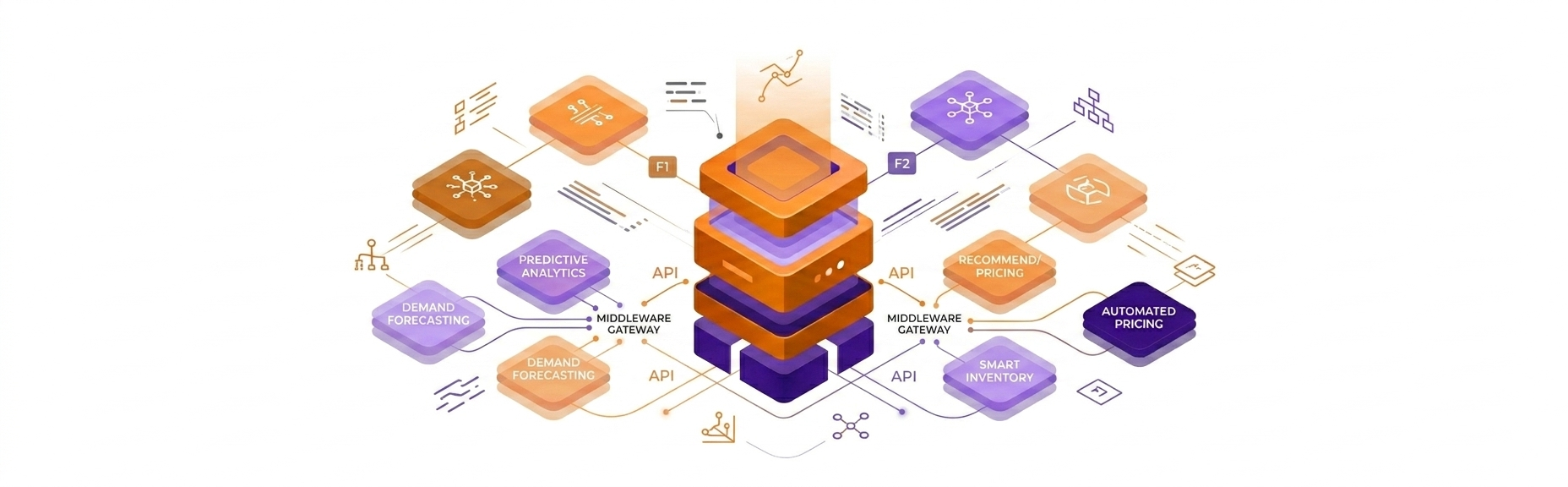
As it stands today, retailers already have disconnected data, legacy checkout systems, and multiple third-party tools in place. To enhance current applications, organizations do not have to replace them, but introduce intelligent capabilities. It can easily be done with the help of APIs, middleware, and service-based extensions. This enables enterprises to upgrade at their own pace, without compromising on stability and performance.
The true worth of integrating AI in e-commerce is helping companies make quicker, smarter decisions on inventory management, enhancing customer experience, and optimizing marketing without interrupting their core operations. If executed accurately, it would be an additive layer, not a disruptive layer.
Layer strategy for API first Integration.
A wise decision to improve systems these days is to choose an API first architecture. The system integration model allows the connection of existing platforms with external services without affecting the core system structure.
To speed up experimentation with new features, companies don’t rewrite backend logic anymore, but simply expose and consume data through APIs. This method is particularly effective to use automation tools in legacy environments.
An increasing number of organizations are using ecommerce AI tools through API gateways, which, in turn, allows recommendation silos, pricing, and customer analytics to share information in real-time. This ensures intelligence features are decoupled and easier to replace and ramp up.
By using API layers, companies can also avoid vendor lock-in and retain flexibility as technology changes. To begin with, systems remain stable as new functionality is added continuously.
Optimizing Data Layer and Mapping Intelligence
At its essence, data creates the cornerstone of any intelligent system. However, most e-commerce platforms do not have access to good datasets. They get by with data that is inconsistent, siloed, or outdated. Before adding sophisticated features, companies should first normalize and structure their data pipelines.
Combining data on customer behaviour and transaction product data into unified data models. Once organized, this data can be used to inform predictive modelling and behavioural segmentation.
At this stage, the incorporation of AI in e-commerce would help convert raw data into actionable insights, like a demand forecast or personalized product recommendations. You can send this data back into existing systems via lightweight connectors.
A well-conceived data layer guarantees that intelligence solutions do not directly affect the core commerce functions. Instead, they serve as analytical overlays that enhance decision-making processes across departments.
Commodities, Microservices and Headless Architecture.
The microservices architecture is essential for enhancing system flexibility. Splitting monolithic systems into independent services allows businesses to quickly build new capabilities without impacting the whole platform.
The decoupling of storefront UI from the backend Merchandising engine of the platform. This separation enables companies to enhance their user interfaces independent of their operating systems.
In this context, upgrade strategies for the AI systems can be activated at a service level. A search optimization module or recommendation engine can be replaced or improved without affecting the checkout or the inventory services.
The possibility of switching to another module helps in reducing risk and improving capacity. This also enables teams to speedily try out new features that are critical in the competitive e-commerce environment.
Design of Integration and Middleware Gateway.
Middleware serves as a connection between old technologies and new tools, facilitating communication without modifying legacy systems. This layer is useful in the larger scenario of e-commerce.
Middleware allows organizations to move data between systems, transform it into different formats and apply logic without altering the core application. The compatibility is sustained due to simplification.
Multiple organizations employ middleware solutions to utilize ecommerce AI technologies like personalization engines or fraud detection systems in real-time. These tools are standalone but will blend with the current workflow.
Through a well-designed integration gateway, everything stays in sync, no matter how many tools or services are being used. By integrating data in a unified manner, you enable customer access to the same information across all channels.
Stepwise Implementation and Gradual Upgradation.
By not going for a complete transformation at once, companies do better with deployment strategies. The strategy employed here begins with low-risk areas like analytics or reporting, advancing incrementally.
After attaining the stability of the first module, further modules like automation, predictive modelling, etc., can be introduced. By doing so, it lowers operational risk, empowering teams to evolve gradually.
An organized AI integration in ecommerce roadmap ensures that every step is developed on the previous step to build a strong foundation for long-term scalability. It also helps the teams to measure impact and make changes based on viable performance results.
Incremental modernization enables large-scale platforms to successfully avoid downtime that could cost revenue and damage reputations.
Supervision, Reactions Circles, and Perpetual Enhancement
After launching the application, monitoring it is key. Intelligent systems require evaluation not just on performance but also accuracy, reliability and ultimately business impact.
Using feedback loops means using a business’s history to refine models and outputs. This comprises monitoring conversion rates, customer engagement metrics, and operational performance enhancement.
The upgrade processes of the AI system become recurring instead of one-time. Systems are continuously evolving with the new data and evolving business requirements.
By incorporating monitoring tools into the architecture, businesses can be sure that all changes stay on strategy.
Finale.
There's no need to throw away your existing system. Rather, it uses modular enhancement techniques designed to introduce intelligence gradually and under control.
Techniques in use today like API-first design, microservices, middleware integration and phased deployment, for example, enable companies to evolve without disrupting their operations. The thoughtful implementation of AI integration in ecommerce can provide a sustainable growth strategy instead of a risky overhaul.
In the same way, the best ecommerce AI tools and a unique AI system upgrade plan enable businesses to remain on the competitive edge, while not compromising on operational stability.
The organizations that add new layers of intelligence to systems they trust will define the future of digital commerce rather than a complete rebuild.
FAQs.
1. What is the best way to initiate AI integration in e-commerce whilst keeping all existing systems unchanged?
It is best to start with API-based integration or middleware layers. It grants the facility to add new functionality to the core without really having to change the basic underlying infrastructure.
2. How does artificial intelligence improve performance in e-commerce?
The use of AI helps in making fast and accurate decisions by enabling personalization, enhancing demand forecasting, and automating repetitive tasks.
3. What does the upgrade of an AI system entail?
The update process of AI models typically entails upgrading existing models, adding new data feeds, and enhancing the automated layers without a complete overhaul.
4. Can AI tools effectively operate with older e-commerce systems?
No, AI tools can link with legacy systems, not through total overhaul but middleware and API gateways.
5. Is it necessary for a complete system replacement?
No It is usually better to integrate slowly than to rebuild a whole business infrastructure.

Join Accelero Community Today!


200+ weekly subscribe